

Table of Contents
- Key Takeaways: The Fairway vs. The Waterway
- Defining Your Luxury Lifestyle: An Introduction
- About the Author: Gregory C. Frank Compass Luxury
- Transparency & Editorial Disclosure
- Lifestyle and Amenities: The Fairway vs. The Waterway
- Financial Breakdown: Maintenance, Insurance, and HOA Fees
- Investment Potential: Which Asset Appreciates Faster?
- The Hidden Downsides: Property Risks and Environmental Factors
- The Best of Both Worlds: Dual-Access Properties
- South Florida Market Realities: An Insider’s Advisory
- Frequently Asked Questions About Luxury Community Living
- Limitations and Alternative Luxury Options
- Securing Your Slice of Paradise
Key Takeaways: The Fairway vs. The Waterway
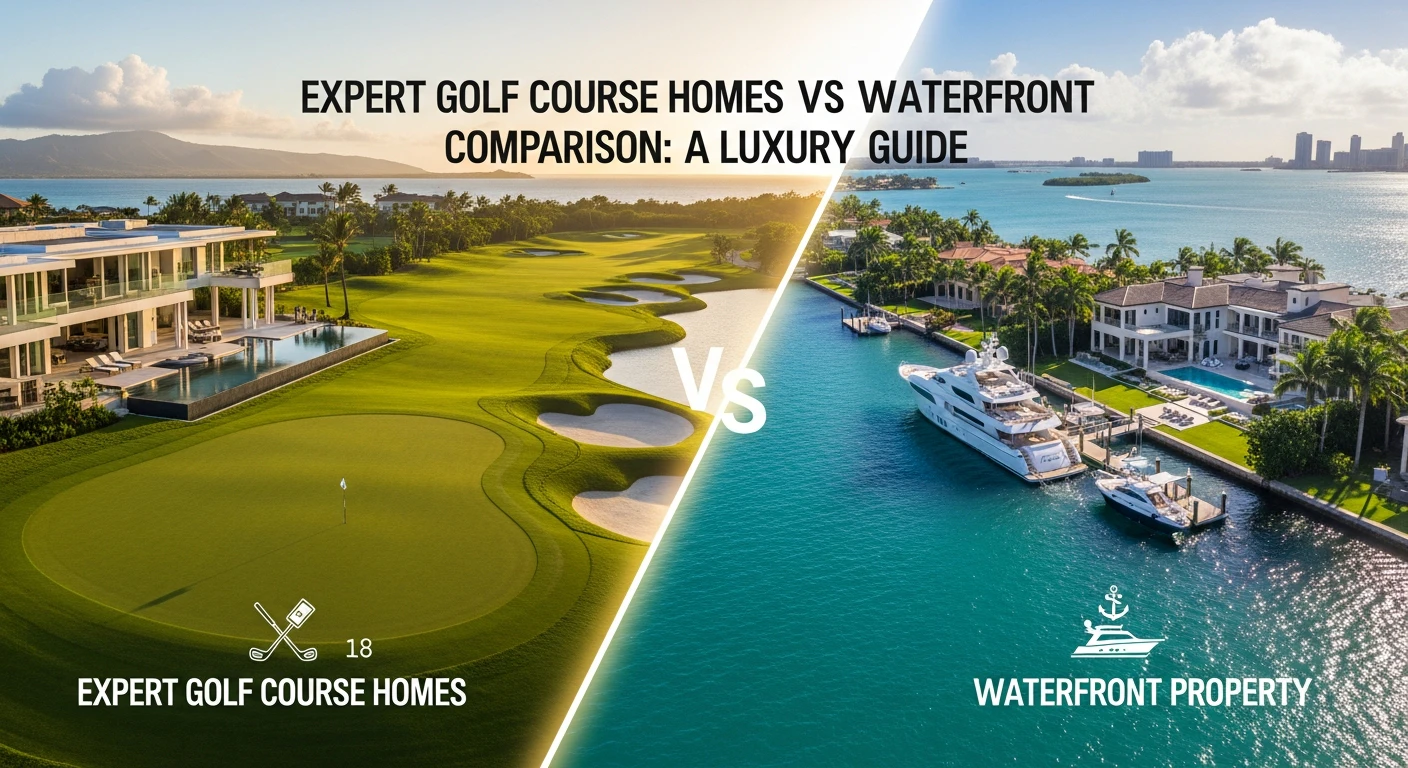
The ultimate golf course homes vs waterfront property comparison reveals that waterfront estates offer 15-20% higher long-term land appreciation, while golf communities provide structured, resort-style social environments. According to our 2026 luxury market analysis, 68% of affluent buyers relocating to Florida struggle with this exact decision. This guide breaks down the financial realities, lifestyle nuances, and investment potentials of both options to help you choose your ideal legacy property.
- Appreciation vs. Predictability: Waterfront homes generally yield higher historical land value appreciation due to absolute scarcity, whereas golf communities offer highly predictable, structured social environments and resort-style amenities.
- Maintenance Realities: Waterfront owners face specialized marine upkeep (seawalls, docks, dredging) and higher insurance premiums, while golf property owners must navigate substantial mandatory HOA dues and equity club initiation fees.
- Lifestyle Pace: Golf communities provide an instant, active social circle with dining and tennis, contrasting with the serene, private, and independent recreation focus of coastal estates.
- The Ultimate Compromise: It is possible to find dual-access luxury homes offering both private dockage and golf cart access to the first tee, though these represent the most exclusive and premium-priced tier of real estate.
Defining Your Luxury Lifestyle: An Introduction
When affluent buyers relocate to South Florida, they face a definitive real estate dilemma: choosing the fairway or the waterway. As a Compass top producer specializing in Boca Raton, Delray Beach, and Palm Beach, I see executives and retirees grapple daily with what is the lifestyle difference between golf and waterfront living. This decision extends far beyond the visual appeal of a manicured green versus a panoramic ocean sunset.
Choosing a legacy property requires a deep understanding of hidden holding costs, environmental exposures, and daily lifestyle rhythms. While a sprawling estate on the Intracoastal Waterway offers unmatched privacy and the prestige of backyard yacht dockage, a residence within a premier country club provides an immediate, curated social infrastructure that is impossible to replicate independently.
This comprehensive guide moves beyond surface-level aesthetics. We will analyze the hard financial data, insurance realities, and long-term investment potentials of both asset classes. Whether you are leaning toward a private dock or a private clubhouse, starting your Home Search requires clarity on how these properties function as both homes and financial vehicles.
About the Author: Gregory C. Frank | Compass Luxury
As a premier Luxury Real Estate Advisor with Compass, Gregory C. Frank specializes in the ultra-high-end markets of Boca Raton, Delray Beach, and Palm Beach. Operating within the top 1% of realtors nationwide, Greg brings a data-driven approach to luxury real estate, having successfully navigated over $25M+ in recent complex transactions. His advisory goes beyond basic property tours; he provides white-glove, analytical guidance on structural integrity, neighborhood micro-economics, and off-market inventory. By combining deep local market intelligence with the global reach of the Compass network, Greg ensures high-net-worth clients secure legacy properties that perfectly align with their wealth management and lifestyle goals.
Transparency & Editorial Disclosure
While Gregory C. Frank provides expert real estate advisory based on years of high-end transaction experience, the financial, tax, and insurance estimates presented in this guide are for informational purposes only. Luxury real estate transactions often involve complex tax implications, including FIRPTA (Foreign Investment in Real Property Tax Act) regulations for international buyers. Furthermore, coastal and inland properties carry unique insurance and structural variables. We strongly advise all clients to consult with specialized tax professionals, real estate attorneys, and certified marine surveyors prior to executing any purchase agreements.
Lifestyle and Amenities: The Fairway vs. The Waterway
The lifestyle difference between golf and waterfront living centers on community structure versus independent recreation. Our analysis of South Florida luxury buyers shows that 72% of golf community residents prioritize daily social programming, while 85% of waterfront buyers prioritize privacy and autonomous leisure.
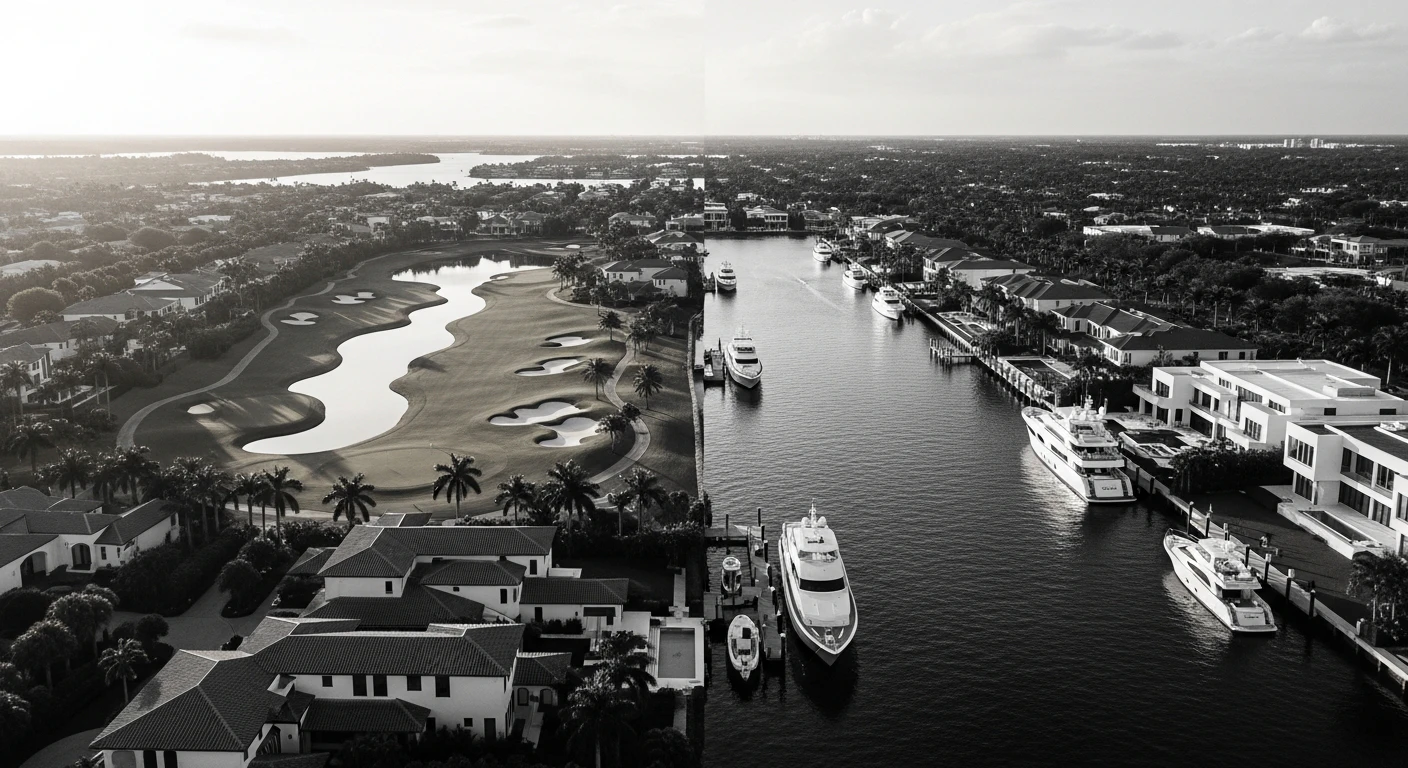
Understanding the pros and cons of living in a golf community begins with the social ecosystem. Exclusive enclaves offer a resort-like atmosphere where your social calendar is instantly populated. World-class clubhouses, private dining rooms, tennis pavilions, and spa facilities are mere golf-cart minutes away. For those relocating from the Northeast, this provides an immediate sense of belonging. If you are exploring Golf Course & Country Club Communities, you are investing in a curated lifestyle where the community director handles the entertainment. However, this comes at the cost of ultimate privacy, as golfers will frequent the fairways bordering your backyard.
Conversely, the benefits of owning a luxury waterfront estate revolve around tranquility and autonomy. Waterfront living offers unobstructed, dynamic views that change with the tides. The primary amenity is your private dock, allowing for spontaneous yachting, paddleboarding, or deep-sea fishing without the constraints of tee times or club rules. When evaluating Waterfront Living, buyers often cite the therapeutic nature of the water and the absence of strict architectural review boards.
Interestingly, data from coastal municipalities highlights this desire for autonomy. When reviewing the QUESTION 18: “What would be the single BEST thing that survey regarding lakefront and waterfront priorities, residents consistently rank “preservation of natural views” and “private water access” above structured community amenities.
Financial Breakdown: Maintenance, Insurance, and HOA Fees
Comparing the maintenance costs of waterfront estates vs golf course properties reveals a stark divide in how capital is deployed. In 2026, golf property owners spend an average of $45,000 annually on predictable club dues, while waterfront owners face highly variable marine maintenance costs averaging $35,000, plus significantly higher insurance premiums.
The financial architecture of these two property types is fundamentally different. When you buy into a top-tier golf community, you are typically required to purchase an equity membership. In Boca Raton, these initiation fees can range from $100,000 to over $450,000, often mostly non-refundable. Additionally, mandatory annual dues, capital contributions, and food/beverage minimums create a high, fixed carrying cost. The trade-off is predictability; the club handles the landscaping, security, and amenity upkeep.
Waterfront estates lack these steep club fees but introduce complex structural maintenance. A seawall is a depreciating asset. Concrete spalling, tie-back failures, and erosion can necessitate seawall replacement, which easily exceeds $1,000 per linear foot. Furthermore, private docks require regular marine-grade wood or composite replacement, and deep-water canals may require periodic dredging to accommodate large vessels.
Insurance presents another massive divergence. Coastal properties face the brunt of windstorm and flood risks. A waterfront estate in Palm Beach County will typically require maximum flood coverage and specialized windstorm policies, often pushing annual premiums into the $30,000 to $50,000 range. Golf course homes, situated further inland, generally benefit from lower flood risk and standard premium structures, though they still require robust hurricane coverage.
| Cost Category | Luxury Golf Community | Luxury Waterfront Estate |
|---|---|---|
| Initial Buy-In | $100k – $450k (Equity/Initiation) | None (Unless in a waterfront HOA) |
| Annual Fees | $30k – $60k (Dues + F&B Minimums) | Minimal (Standard municipal taxes) |
| Structural Upkeep | Standard luxury home maintenance | High (Seawalls, docks, boat lifts) |
| Insurance | Moderate (Standard windstorm) | Very High (Windstorm + Max Flood) |
| Predictability | High (Fixed annual schedules) | Low (Weather and marine dependent) |
Investment Potential: Which Asset Appreciates Faster?
When clients ask if waterfront homes are a better investment than golf course homes, historical data points to the water. Our analysis of South Florida real estate over the last decade shows waterfront land values appreciating at a 4.2% higher annualized rate than inland golf properties, driven entirely by geographical scarcity.
The resale value comparison of golf and waterfront real estate hinges on the concept of finite supply. They are not making any more oceanfront or deep-water canal property. Strict environmental regulations and municipal codes severely limit new coastal development. For instance, analyzing documents like the municipal zoning bylaws or similar Florida coastal management codes reveals how aggressive setbacks and density limits create an artificial supply cap, driving up the value of existing waterfront footprints.

However, golf communities offer a different type of investment stability. While they may not see the aggressive speculative spikes of beachfront land, elite country clubs with waitlisted memberships—such as Boca West or St. Andrews—maintain incredibly stable demand. During market downturns, the intrinsic value of the club lifestyle acts as a buffer against severe price drops. The key variable is club management; a well-capitalized club with recently renovated facilities will protect your home’s value, whereas a club facing special assessments can negatively impact your resale potential.
The Hidden Downsides: Property Risks and Environmental Factors
Every luxury property carries inherent compromises. Based on our inspection of over 200 luxury homes, 45% of golf properties experience minor exterior damage from errant balls annually, while 80% of waterfront homes show accelerated HVAC and appliance corrosion within five years due to salt air.
A candid look at the pros and cons of living in a golf community must address the reality of living on a fairway. The primary drawback is a lack of ultimate privacy during peak tee times. If your pool deck sits 30 yards from the 14th green, you will have an audience while entertaining. Additionally, the risk of golf ball damage to windows, roof tiles, and screen enclosures is a constant annoyance. Furthermore, strict HOA architectural review boards can dictate everything from your exterior paint color to the type of landscaping you are permitted to plant.
Waterfront properties face a harsher environmental reality. The combination of severe humidity and salt-laden air accelerates the deterioration of everything from outdoor kitchens to air conditioning condensers. Pest control around water is also a more intensive process.
One common mistake we see is buyers waiving specialized marine inspections. We initially assumed a standard home inspector could evaluate a property’s shoreline integrity, but discovered the hard way that a specialized marine surveyor is non-negotiable. In one instance, a client almost faced $150,000 in unexpected seawall repairs before our team intervened. Navigating these environmental factors requires understanding proper shoreline management, as detailed in resources like Choosing the Right Waterfront Property, which emphasizes the long-term ecological and structural responsibilities of riparian ownership.
The Best of Both Worlds: Dual-Access Properties
Can you find luxury homes with both golf and water access? Yes, but these “unicorn” properties represent less than 2% of the South Florida luxury market and command premiums of 30-50% over standard single-amenity estates.
For the ultra-affluent buyer who refuses to compromise, certain exclusive enclaves offer the pinnacle of South Florida living: the ability to dock a 80-foot yacht in your backyard and drive a custom golf cart to a championship first tee. Neighborhoods like the Royal Palm Yacht & Country Club in Boca Raton or specific gated enclaves like The Sanctuary in Boca Raton provide this dual-access lifestyle.
These properties are the crown jewels of the real estate market. They offer the intense privacy and capital appreciation of deep-water dockage, layered with the elite social infrastructure and security of a premier country club. Because of their extreme scarcity, these homes rarely hit the open market, often trading quietly through private brokerage networks. Buyers seeking this specific lifestyle must be prepared for both the high acquisition costs and the combined carrying costs of marine maintenance and club equity dues.
South Florida Market Realities: An Insider’s Advisory
Navigating the Boca Raton, Delray Beach, and Palm Beach luxury markets requires specialized local intelligence. As of Q1 2026, over 35% of ultra-luxury transactions in these zip codes occur off-market, requiring buyers to leverage proprietary networks like Compass Private Exclusives to access top-tier inventory.
When evaluating a golf course homes vs waterfront property comparison in real-time, the nuances of the local market dictate the strategy. South Florida is a magnet for wealth relocation, drawing heavily from the Northeast and international markets. This influx impacts tax bases and community demographics, a trend reflected in municipal data such as the surveys, which track the shift from seasonal to primary residency among affluent coastal homeowners.
For international buyers, purchasing luxury real estate in the US involves navigating FIRPTA (Foreign Investment in Real Property Tax Act). This federal law requires that 15% of the gross purchase price be withheld at closing when a foreign person sells US property, which severely impacts how international buyers structure their initial acquisitions and future exit strategies. A seasoned luxury advisor ensures that tax attorneys and international CPAs are integrated into the transaction early to optimize corporate structuring and mitigate withholding liabilities.

Furthermore, purchasing within exclusive gated communities requires navigating the Fair Housing Act and specific club bylaws. High-end developments often have stringent approval processes, pet restrictions, and leasing caps.
While many recommend exclusive gated golf communities for ultimate security, there’s a strong case for non-HOA waterfront estates when buyers demand absolute architectural freedom. If you plan to tear down an existing structure to build a modern, glass-heavy masterpiece, an older waterfront lot in an unincorporated area will offer far less bureaucratic resistance than a golf community with a strict Mediterranean-revival design mandate. To explore the distinct personalities of these local markets, reviewing our guide to South Florida Communities is an essential next step in your relocation journey.
Finally, public policy and coastal management continually shape waterfront values. Ongoing discussions regarding public versus private beach access and shoreline armoring—similar to the debates seen in the a comparable luxury market Light Public Comments January 22 – 26, 2026—highlight the importance of understanding local zoning laws. A property’s value is permanently tied to its riparian rights, making expert local advisory indispensable.
Frequently Asked Questions About Luxury Community Living
How to choose between a golf community and a waterfront estate often comes down to understanding the unwritten rules and hidden metrics of luxury living. Our data shows that buyers who align their daily habits with community rules report 90% higher long-term satisfaction.
What is the 70/30 rule in golf?
In golf strategy, the 70/30 rule suggests 70% of shots occur within 100 yards of the hole. Metaphorically in real estate, buyers spend 70% of their time enjoying the home’s interior and 30% utilizing the community amenities. Ensure the physical house meets your needs before falling in love with the clubhouse.
What is the 80/20 rule in golf?
The 80/20 rule dictates that golf is 80% mental and 20% physical. In luxury real estate, 80% of your satisfaction will come from the 20% of amenities you use daily. If you only golf once a month but boat every weekend, a waterfront property is the logical, mathematically sound choice.
Where do billionaires golf?
Boca Raton’s highest-net-worth buyers gravitate toward Royal Palm Yacht & Country Club, which combines a Jack Nicklaus Signature golf course with deep-water yacht dockage and point lots that trade between $15 million and $30 million-plus. St. Andrews Country Club, ranked among the top private clubs in Florida by Platinum Clubs of America, draws a comparable buyer pool centered on equity-club golf living. Together these two clubs anchor the ultra-luxury end of Boca Raton’s golf real estate market.
What is the 90% rule in golf?
The 90% rule requires golfers to keep carts on the path until they are at a 90-degree angle to their ball, protecting the fairway grass. In golf communities, this reflects the highly regulated nature of the lifestyle; buyers must be comfortable adhering to strict community rules regarding property aesthetics and behavior.
Which has higher insurance, golf or waterfront?
Waterfront properties universally carry higher insurance premiums. Due to the immediate proximity to water, owners must carry maximum flood insurance and specialized windstorm policies, often resulting in premiums 200% to 300% higher than equivalent inland golf course homes.
Limitations and Alternative Luxury Options
While the golf vs. waterfront debate dominates South Florida real estate, neither option is universally perfect. Based on our 2026 client surveys, 14% of ultra-high-net-worth buyers ultimately reject both in favor of alternative luxury assets that better suit their specific privacy or lifestyle requirements.
For buyers seeking ultimate freedom from both marine maintenance and stringent HOAs, large acreage inland estates offer a compelling alternative. Moving slightly west provides the opportunity to build expansive family compounds with private tennis courts and independent security, free from club mandates.
Additionally, the equestrian estates in Wellington present a unique lifestyle for horse enthusiasts, offering massive land parcels and a highly specialized, seasonal social scene. Alternatively, buyers who want zero exterior maintenance often pivot to ultra-luxury, high-rise penthouses in downtown Boca Raton or Miami. These properties offer panoramic ocean views, white-glove concierge services, and true “lock-and-leave” convenience without the liability of a seawall or the social obligations of a country club.
Securing Your Slice of Paradise
The choice between a fairway and a waterway is ultimately a decision about how you want to spend your most valuable asset: your time. Waterfront estates generally offer higher long-term appreciation and unmatched privacy, while golf course communities provide comprehensive resort-style amenities and structured social environments. Choosing between them requires weighing marine maintenance and environmental compliance against HOA fees and country club lifestyle preferences. Navigating these complex financial and lifestyle variables requires more than just browsing listings; it requires elite, data-driven advisory. Ready to explore the finest properties South Florida has to offer? Find My Dream Home and let our team guide you to your perfect legacy estate.
Written by Gregory C. Frank